
When Valassis Digital was in the middle of a rebrand, the UX team used the opportunity to re-evaluate their default typeface. There had been complaints of legibility issues from clients and staff.
I was tasked with carrying out research to help select a new typeface that 1) is legible at small sizes, and 2) is well liked. After consulting with the Visual Design team we narrowed the choice down to 3 font families.
I then built an experiment to test the legibility of the 3 competing fonts, and paired that with a subjective preference assessment. The study’s experimental design made it possible to not only determine which letters were most frequently missed, but what letters they were most often confused for (i.e. mistaking a v for a w).
I used Psytoolkit to build and host this experiment entirely online, so the participants could take the experiment remotely, on their personal computers. This meant that we could use Amazon’s Mechanical Turk platform to quickly recruit and run participants. The massively parallel online data collection allowed for rigorous experimentation to be conducted quickly and affordably, without sacrificing data quality.
A snapshot of key findings can be found below.
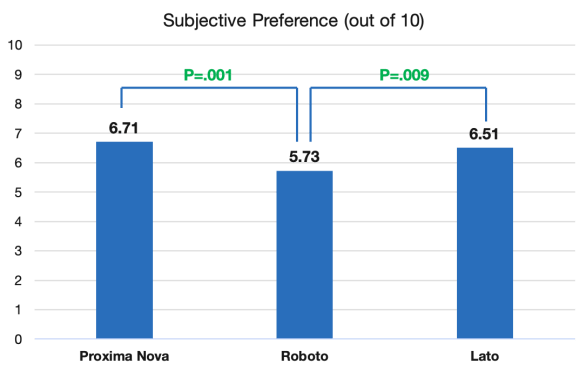
Above you can see that 2 fonts were clearly preferred over the third.
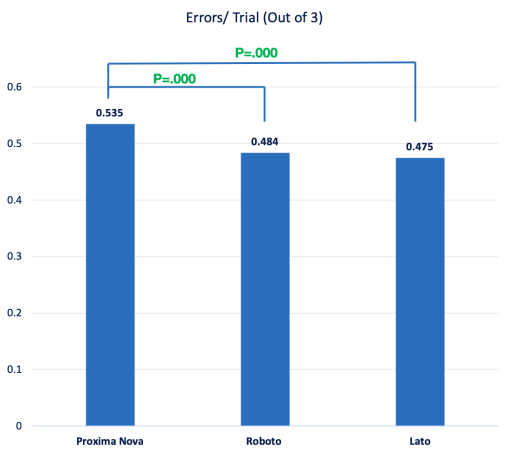
When we look at legibility, however, we see an entirely different story. The font with the highest subjective preference ratings (Proxima Nova) turned out to be the least legible, demonstrating a dissociation between preference and legibility.
This project highlights the importance of being able to conduct quality research with a short turnaround time; had we relied only on simpler survey methods, a typeface that did not satisfy user legibility needs would likely have been chosen. After presentation of these findings Valassis Digital decided to use Lato, which scored highly on both subjective preference and objective legibility measures.
 Patrick Lawson, PhD